Thursday, June 2, 2011

Creating and linking multiple Pages


This explains how to create a small web site with multiple pages that has links along with them.  First you have to create a web page called index. Most of the time index means the home page of the site you are going to create.

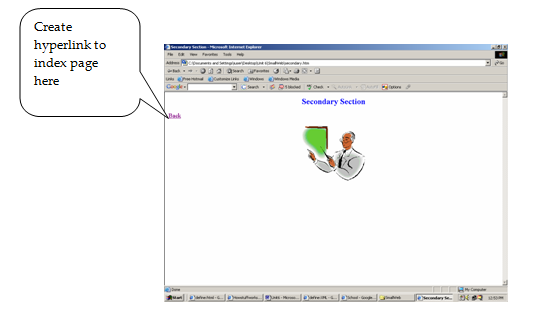
Next you have to create other pages. The two other pages available in this example are as follows
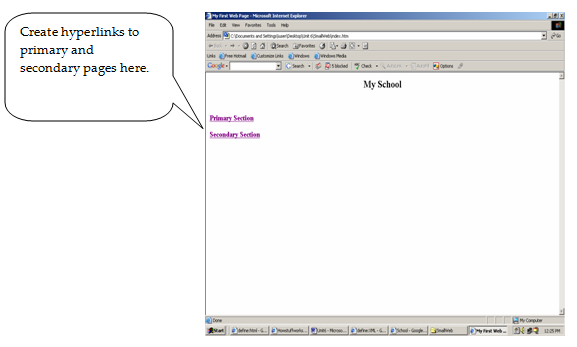
After creating other pages create hyperlinks from index page to primary and secondary pages.

<html>

<head>
<title>My First Web Page</title>
</head>

<body>
<p align="center"><b><font size="5">My School</font></b></p>
<p align="left">&nbsp;</p>
<p align="left"><font size="4"><b><a href="primary.htm">Primary Section</a></b></font></p>
<p align="left"><font size="4"><b><a href="secondary.htm">Secondary Section</a></b></font></p>
</body>
</html>

...................................................................


<html>
<head>
<title>Primary Section</title>
</head>
<body>
<p align="center"><b><font size="5" color="#FF00FF">Primary Section</font></b></p>

<p align="left"><b><font size="4"><a href="index.htm">Back</a></font></b></p>

<p align="center"><img border="0" src="primary.jpg" width="180" height="204"></p>

</body>

</html>
.............................................................................

<html>

<head>
<title>Secondary Section</title>
</head>

<body>

<p align="center"><b><font size="5" color="#0000FF">Secondary Section</font></b></p>

<p align="left"><font size="4" color="#0000FF"><a href="index.htm">Back</a></font></p>

<p align="center"><img border="0" src="secpic.wmf" width="193" height="165"></p>

</body>

</html>

..................................................................................................


Using HTML codes in a text editor is the Basic method to create a web page. The concept of HTML codes and tags is very important in this method. 


.

Creating a Simple Web Page

 
To create a web page there are two methods 


  1. Create web page using a text editor
Eg: Note Pad

  1. Create web page using standard package
Eg: Microsoft Front Page, Macromedia Dreamviewer and Adobe Fireworks 

Create a web page using a text editor


<html>

<head>
<title>New Page 1</title>
</head>

<body>

My First Web Page

</body>

</html>


Create a web page using standard package


For example, HTML code generated by FrontPage is as follows
<html>

<head>
<meta http-equiv="Content-Language" content="en-us">
<meta name="GENERATOR" content="Microsoft FrontPage 5.0">
<meta name="ProgId" content="FrontPage.Editor.Document">
<meta http-equiv="Content-Type" content="text/html; charset=windows-1252">
<title>New Page 1</title>
</head>

<body>

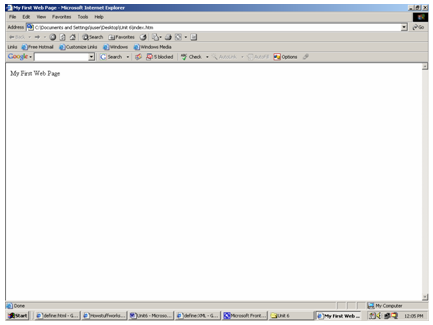
<p>My First Web Page</p>

</body>

</html>


Preview of the desired web page on a Web Browser


.

Wednesday, June 1, 2011

Web Page Development


Fundamentals of HTML


Hypertext Markup Language, the coding language used to create hypertext documents for the World Wide Web. In HTML where a block of text can be surrounded with tags that indicate how it should appear (for example, in bold face or italics). Also, in HTML a word, a block of text, or an image can be linked to another file on the Web. HTML files are viewed with a World Wide Web browser.
This is a subset of Standard Generalized Markup Language (SGML). This language provides codes used to format hypertext documents. Individual codes are used to define the hierarchy and nature of various components of a document, as well as to specify hyperlinks.

HTML documents are written in plain text, but with the addition of tags, which describe or define the text they enclose. For example, the ANCHOR <A> tag placed around the hyperlinked text defines a link. It specifies the URL of the 'linked to' document, eg <A HREF="http://www. ...


Fundamentals of XML


Extensible Markup Language; defined by the World Wide Web Consortium (W3C) (2004b) as “a class of data objects called XML documents partially describes the behavior of computer programs which process them. XML documents are made up of storage units called entities, which contain either parsed or unparsed data. Parsed data is made up of characters, some of which form character data, and some of which form markup. ...
It is a W3C-recommended general-purpose markup language for creating special-purpose markup languages. It is a simplified subset of SGML, capable of describing many different kinds of data. Its primary purpose is to facilitate the sharing of data across different systems, particularly systems connected via the Internet.


.